
Decode Madison County Property Tax Records
The assessor and the collector answer different questions. Keep each official field under its own label, and keep the selected year attached to every figure.
| Field | What It Shows | Where |
|---|---|---|
| Land and improvement | Separate appraisal components | Tax Assessor |
| Total appraised | Portal appraisal label | Tax Assessor |
| Taxable and assessment | Distinct tax-treatment values | Tax Assessor |
| Exemptions | Codes and homestead indicators | Tax Assessor |
| Bill and status | Tax, paid amount, balance, penalty and interest | Tax Collector |
| Tax district | County or municipal routing code | Assessor and GIS |
Neither the bill nor the assessment is a recorded sale price. For what a property actually sold for, the deed is the better source.
Five Values on One Madison County Lot
One official vacant-lot example in Madison County shows how the labels stack up. The parcel card lists $45,000 in land, no improvement value, $45,000 total appraised, $33,750 taxable, and $6,760 in assessment value, with a use value of $0. None of those figures are interchangeable. The 2026 bill for the same lot totals $226.46 in tax, with the balance shown alongside. Review the official parcel-card example to see the fields in place.
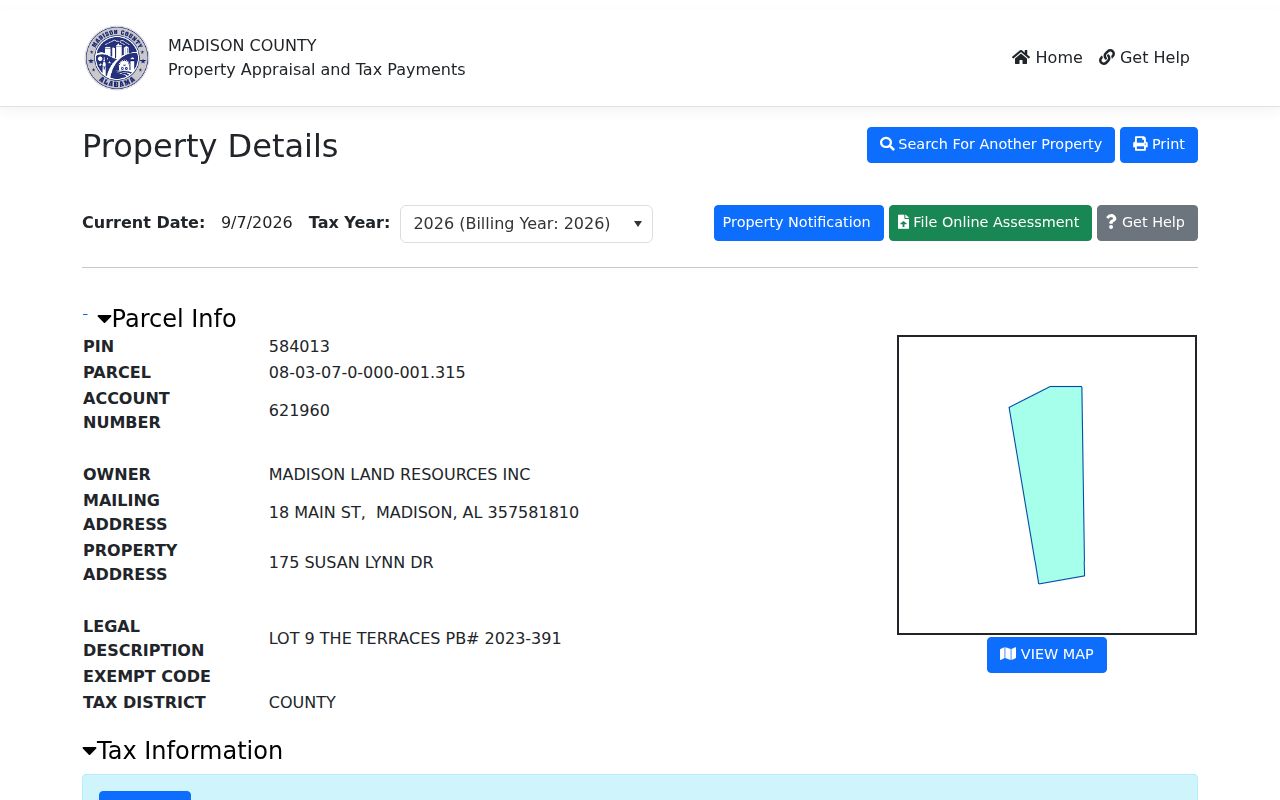
The image keeps valuation, assessment, and current-bill fields clearly separated. It also shows why the tax year must travel with every number you take from the record.
Use Seven AssuranceWeb Search Modes
AssuranceWeb search supports seven modes: Name, PIN, Company, Parcel, Account, Subdivision, and Address. Name mode requires a last name. It allows an optional first name, and offers starts-with or contains matching. Address mode splits the street number from the street name. Each result line shows the description, account, parcel, and year. It also shows billing year, PIN, total tax, and balance.
| Route | Input | Tax advantage |
|---|---|---|
| PIN | Short numeric ID | Exact parcel match |
| Account | Billing account | Direct bill key |
| Address | Number and street | Known-property start |
| Owner/company | Name text | Multiple associated accounts |
| Subdivision | Development name | Vacant lots |
Look Up a Madison County Tax Bill
Start by resolving the PIN and account, then take them to the Tax Collector's current-year route. Online information uploads frequently, but it can still lag behind what happens at the counter.
- Find the parcel and capture PIN, account, tax year, and district.
- Read total tax, balance, penalty/interest, paid amount, and history.
- Review exemption indicators without treating them as occupancy proof.
- Check delinquency dates and tax-sale information; call for same-day status.
- Assessment value
- The field used with applicable tax treatment.
- Levy or mill rate
- The rate component used to calculate tax.
- Homestead exemption
- Qualified primary-residence relief that is not automatic.
- Tax lien
- A statutory claim arising from unpaid property tax.
Follow the October-to-May Tax Calendar
The official calendar sets the rhythm for the year. Taxes are due October 1 and delinquent after December 31. Final real-estate delinquent notices go out in February. March 31 is the last day to pay real-estate tax by check or card. From April 1 through the sale, only certified funds and cash routes apply. The annual online tax-lien sale begins the first week of May.
The tax-sale page covers registration, bidding, redemption, and certificates. A lien sale is not an immediate sale of the land. It is also not permission to occupy it.
Claim Madison County Exemptions
The homestead page explains residence timing, required proof, and the H-2, H-3, and H-4 categories. Exemptions are never automatic. After a deed change, an exemption may need to be reclaimed with the assessor. A blank code on a record proves only what that screen displays, so bring the exact parcel and the required eligibility evidence when you apply.
Verify Payments and Avoid Tax Scams
The Collector sits at 1918 Memorial Parkway NW in Huntsville, reachable at 256-532-3370, open 8:30 to 4:30. Payment guidance lists online, in-person, and mail routes. Card payments carry a 2.75% charge plus $0.30, and e-checks cost $1.50. Confirm current fees before paying. The office says it will never call asking for bank or routing information, so return to the official county number if a caller demands those details.
Note: For activity too new for the portal, verify the balance directly with the Tax Collector.
Separate the October 1 Snapshot From Current Ownership
Ownership on the tax roll reflects October 1. A deed recorded later can leave the roll showing a prior owner of record. So always weigh the deed date against the tax year before treating any parcel listing as current. The Collector's records may also run ahead of what the assessor's web display shows. Note each date you rely on rather than calling an undated screen current.
A mailing address is not the property address. It simply tells the county where to send the tax bill. It can differ from the situs. One example: mail goes to 18 Main Street. The parcel sits at 175 Susan Lynn Drive. That mismatch proves nothing about occupancy or eligibility. It is a normal feature of how Madison County keeps its property records.
Use Every Madison County Tax Access Channel
Online search is only one channel. The Tax Assessor sits on the second floor at 1918 North Memorial Parkway in Huntsville. It is open weekdays 8:30 to 4:45. Reach it at 256-532-3350 or taxassess@madisoncountyal.gov. The Tax Collector shares the 1918 Memorial Parkway NW address. It is open 8:30 to 4:30. The number is 256-532-3370, or mctaxcoll@madisoncountyal.gov. A Madison satellite office operates at 100 Plaza Boulevard. Mail procedures cover payments and address updates. Old assessment and plat books can be researched through the assessor.
The published address-update form asks for the owner, mailing information, PIN, phone, and email. It also repeats the county's key tax timing. Follow the office-specific procedure and fee schedule. Probate recording charges and Circuit Clerk search fees do not apply to ordinary assessor or collector lookups. When a correction affects ownership rather than correspondence, ask whether a recorded deed is needed too.
At the counter or by phone, identify both the property and the year. Ask whether a displayed balance includes activity posted after the public upload. Ask whether certified funds are required at that stage of the delinquency calendar. Ask whether an exemption application belongs with the Assessor. Never send banking details in response to an unsolicited call. Start any payment only from the county's published channel.
Read Tax History Without Inventing a Trend
A sample tax history illustrates the trap. The 2026 tax of $226.46 is currently unpaid. The 2025 row shows a payment on December 29, 2025 by Homes Murphy. The owner of record still reads Madison Land Resources Inc. A payer name is not automatically the owner. Two annual rows cannot support a countywide trend.
For a defensible parcel comparison, track the same fields across consistent years: land, improvement, appraised, taxable, assessment, exemption, total tax, paid status, and payment date. Then check for a deed date or property change before crediting the difference to appreciation, construction, an exemption, or reclassification. A vacant lot has no improvement component. Do not stack it casually against an improved neighboring parcel.
County collection statistics offer scale, not parcel value. The Collector reported 2023 collections of $416,864,919.06 across 194,912 parcels, a 20.99% increase over 2022. Those aggregates say nothing about what one property is worth. Alabama's separate assessment ratios and the current 7% cap likewise should not be collapsed into a sale-price estimate. Read the portal labels and the property's classification first. Only then apply a statewide explanation.
Distinguish a Tax Lien From the Land
Delinquent-tax research follows its own legal sequence. The county sells a lien certificate through its published tax-sale procedure, with bidding, redemption, and certificate rules attached. Before relying on any tax-sale entry, match the PIN, owner, legal description, year, balance, and sale status. Then read the current Collector instructions.
A lien purchase is not a warranty deed. Redemption rights and statutory steps still control the outcome. Use Probate deed records to check for any later recorded conveyance, and get qualified advice before asserting rights in a tax-sale certificate.
Contest a Madison County Assessment
The assessor's appeal guidance walks through the review, the Board of Equalization hearing, and a Circuit Court appeal. The current county notice set April 30, 2026 for written protest while older portal text remained visible. Confirm the live annual deadline. Deadlines change. Preserve the notice, corrected characteristics, photographs, comparisons, and proof of filing.
Start with the parcel card. Legal description, land use, acreage, improvement details, classification, exemptions, and each value field all matter. A concrete error persuades. The bill alone does not. If the Board decision goes to Circuit Court, follow the county's instructions on the appeal period and on paying the prior-year amount or posting a supersedeas bond. Track payment and valuation separately.
Appeal window. Verify the current Board of Equalization deadline with the Tax Assessor rather than relying on an older portal banner.
Before filing, separate a market disagreement from a correctable data error. Not every grievance is an error. A wrong improvement description, land-use code, classification, parcel size, or exemption status calls for different documentation. Use the county's current form and instructions, identify the PIN and tax year, state the requested correction, and keep proof of timely delivery. Comparables must truly compare. Match use, location, condition, and assessment period. Never pick one just for its lower tax.
Watch the Collector during the contest. The appeal does not erase a due date, delinquency consequence, or statutory payment requirement. Confirm whether the prior-year amount must be paid and whether a later Circuit Court appeal requires a supersedeas bond. Save each notice, receipt, board decision, and court filing. Together they form a dated record trail.
Recheck AssuranceWeb and the bill afterward. Never assume both systems updated together. Compare the revised appraisal, taxable and assessment values, exemption codes, total tax, and balance. If only one office shows the change, give its custodian the decision or correction reference and ask about the update schedule.