
Read the Madison County Owner-of-Record Card
On AssuranceWeb, the current owner appears next to the parcel's core identifiers. Those identifiers matter more than the name alone, since they confirm which piece of land the roll describes.
| Owner Name | Party listed for the displayed tax year |
|---|---|
| Mailing Address | Destination for tax correspondence |
| Situs | Address assigned to the land |
| Last Sale Date | Date shown in the parcel summary |
| Deed Reference | Type, book, page, or document link |
The record names an assessed owner, not an occupant. A different mailing address is normal for vacant land, a company, a trust, or anyone who receives mail elsewhere.
A Madison County Current-Owner Test Case
Consider a vacant-lot card for PIN 584013, account 621960. It names Madison Land Resources Inc. The mailing address differs from the Susan Lynn Drive situs, and a 2023 warranty deed reference sits alongside. The AssuranceWeb parcel summary displays that record card in its official setting.
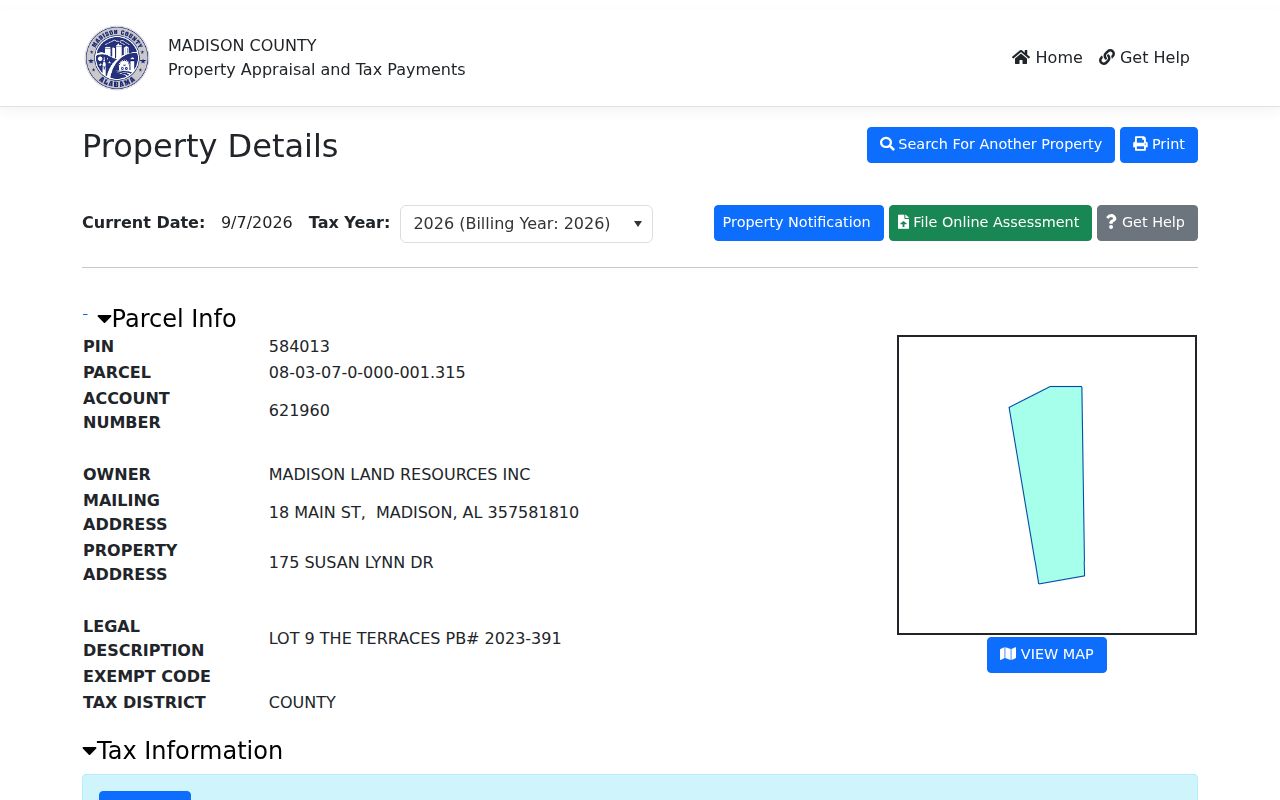
The card's acreage field is blank. Along with the vacant land-use clues, it shows why the current owner field must never be read as proof of occupancy or improvements.
Madison County GIS Has Three Owner Labels
Madison County GIS carries three owner labels. The official parcel layer exposes PropertyOwner, AccountOwner, and PreviousOwners. PropertyOwner and AccountOwner support a present-record check. PreviousOwners points backward but never replaces a deed chain. Before treating two owner labels as the same tract, compare the GIS PIN, parcel number, and legal description with AssuranceWeb, since a publication delay can leave the systems disagreeing for a time. Note: The owner field is strongest when its parcel number, situs, legal description, and deed reference all align.
Separate Madison County Mailing and Situs Addresses
The mailing address is where tax notices go. The situs describes the parcel location. The two can differ without signaling an error. A company-owned tract may send mail to an office, and unimproved land may carry a situs describing the tract even where no one receives mail there.
- Owner of record
- The party named for assessment purposes.
- Assessment roll
- The tax-year record holding owner and value fields.
- Situs
- The property's assigned location.
- Recording lag
- The interval before a later deed reaches another county system.
Watch a Madison County Owner With a PIN Alert
The county's free Property Change Notification service enrolls a PIN. It is an early notice tool. When a Probate deed changes the owner name listed in the Assessor system, an email follows. Keep the enrollment PIN. Compare any alert with the new deed and parcel card rather than treating it as proof.
Confirm the Madison County Current Owner
Use the roll for the current displayed name. Then test that name against the newest recorded conveyance, a narrow workflow that keeps a present-owner check from sprawling into a full history search.
- Search AssuranceWeb by address and copy the PIN and owner name.
- Follow the deed reference or search the name in Probate recorded documents.
- Read the latest grantee and verify the legal description points to the same parcel.
- If an entity is named, keep the entity distinct from its agent or signer.
- Owner of record
- The party shown on the roll.
- Grantee
- The party receiving the interest in the deed.
- Registered agent
- An entity contact, not necessarily an owner.
Recent Madison County Deeds Sit Behind Sign-In
The Probate Recorded Documents portal requires a free account. Direct result links return to the sign-in gate. Recent deeds sit behind that sign-in. When the latest deed cannot be confirmed online, contact the Probate recording office; in-person and phone follow-up remain part of the access chain. For older material, the historic archive in Owens Cross Roads is an appointment option.
How Current Is Madison County's Owner Record?
October 1 sets the assessment snapshot. Online information is uploaded frequently. The Tax Collector cautions it can lag actual office activity, so a deed recorded after the snapshot may be newer than the owner name on a tax card.
Recent-sale check. When the roll and deed differ, date both records and ask the custodian whether an update is pending; the newest recorded deed is the more current evidence.
A stale Board of Equalization notice can linger in the portal. The county page may show a newer deadline. When the two disagree, that mismatch reinforces the habit of recording the page date and the tax year attached to any owner conclusion.
Read a Madison County Entity Owner in Present Tense
When AssuranceWeb lists an LLC, corporation, trust, or estate, that formal name is the owner label to preserve. Never swap in a signer or manager. Never substitute a trustee, beneficiary, or registered agent either. Those people may hold roles connected to the entity without owning the parcel in their personal names. The county portal offers separate modes. Search the company field as well as the owner field.
For an Alabama business, the Secretary of State Business Entity Records can separate entities that use similar words. Compare the entity spelling, suffix, and state identity against the deed grantee. The state record can identify the company that should receive process or filings. It does not turn an agent into a landowner. The deed and parcel description remain the ownership checks.
Trusts and estates call for the same restraint. The roll may show a trust or estate name. The deed may instead name a trustee, executor, or administrator acting in a representative capacity. Record the wording exactly as shown, including the role. If a recent estate transfer has not reached the roll, ask Probate for the indexed conveyance. Never edit the owner conclusion from an obituary or directory clue.
Stop once the present interest is confirmed. Earlier grantors belong in a separate backward chain. That boundary keeps the result easy to date and prevents a prior owner, company organizer, or personal representative from being presented as the party shown now.
Madison County Current-Owner Access Beyond the Web
AssuranceWeb and ISV3 are only the starting points. When an address search comes up empty, try PIN, parcel, account, subdivision, owner, or company names. Use whatever fields the portal allows. The Tax Assessor keeps the assessment and mapping records for Madison County. Staff there can sort out a confusing parcel card, an old appraisal entry, or a plat reference. The Tax Collector handles tax-bill questions. That office notes that online tax data can lag behind what the counter shows.
Deeds and other land instruments are recorded by the Probate Judge. The recording portal requires a free account. Its public pages state no confirmed starting year for online deed records. When a deed is out of reach online, contact the office directly or visit in person. Bring the details you already gathered. That includes deed type, year, book or document number, grantor, grantee, PIN, and legal description. Some older records sit in the historic archive appointment location in Owens Cross Roads.
A precise request beats a vague one. Ask for the parcel card for a stated tax year. Or ask for the index entry for a named instrument. Or request a copy of the latest deed tied to a reference number. Comparing the official record yourself works far better than asking staff for a title opinion. They do not provide one.
Property Change Notification keeps access going afterward. Enroll a PIN. The system then sends an email whenever a Probate deed changes the owner of record in the Assessor system. Keep the original parcel key handy. Addresses and displayed owners can shift over time. The PIN stays the link that the alert relies on.
Contact a Madison County Owner Lawfully
The tax-roll mailing address is the official public clue for reaching an owner. Use it when a boundary question, purchase inquiry, or deed issue calls for contact. It is not a promise that the owner of record lives at that address.
Lawful use. A respectful property-related letter is a proper use of a public mailing address. Never use current-owner data to harass, intimidate, or target anyone.