
Follow the Madison County Owner Trail
Begin with the official Madison County AssuranceWeb property search. An address lookup there returns the PIN, parcel number, account, tax district, and owner name in a single result.
- Search the street number and name, then select the matching description and tax year.
- Copy the owner of record, PIN, parcel, account, and mailing address.
- Confirm the parcel key and legal description in Madison County GIS.
- Use the deed reference in Probate records and read the latest grantee.
Address, Name, and Company Searches in Madison County
AssuranceWeb splits its queries by address, owner, and company. Owner mode accepts starts-with or contains matching. Broad terms can get noisy, since Madison is also a city, a surname, and a common business word.
| Starting clue | Best search | Next check |
|---|---|---|
| Street address | Street number and address | Match legal description |
| Person | Owner | Filter by PIN or district |
| Business | Company | Compare deed and entity name |
Parcel or PIN is the strongest key after the owner name changes.
What the Madison County Parcel Card Calls an Owner
The parcel card names an owner. It never says who lives there. Alongside the owner, the card shows a separate mailing address and situs, and the official parcel summary displays the exact fields used to trace who owns this property.
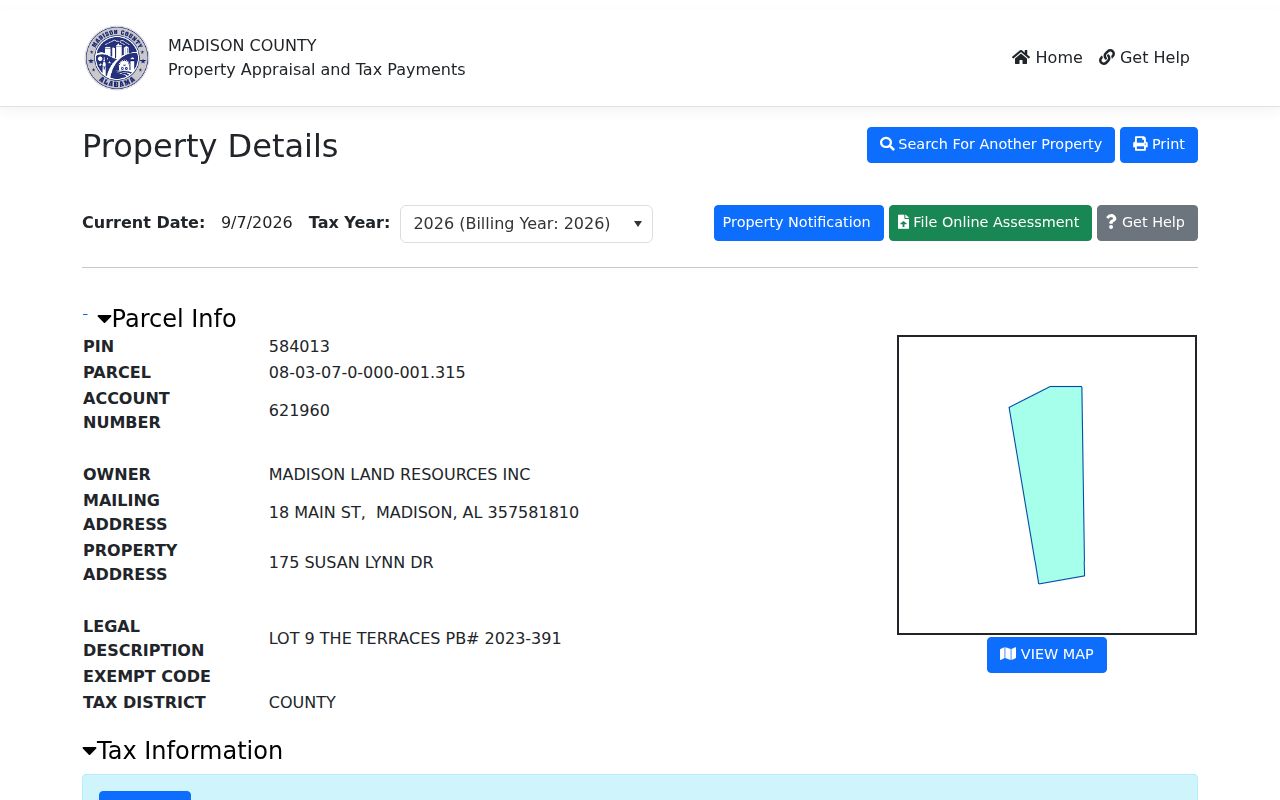
Owner, PIN, account, value, and deed reference sit together on one screen.
- Owner of record
- The party named on the assessment roll.
- Situs
- The parcel location, not its mail destination.
- Grantee
- The party receiving an interest in a deed.
- Title
- Legal rights that a simple lookup cannot establish.
Check a Madison County Property Owner in GIS
Start with the Madison County ISV3 viewer. It searches owner, parcel, PIN, address, or subdivision, with layers for PropertyOwner, AccountOwner, PreviousOwners, legal description, deed book and page, tax district, and value fields. The map shape and parcel number separate lookalike addresses. PreviousOwners is a lead, not a chain. Note: A parcel map helps confirm identity, but its displayed lines are not a legal boundary survey.
When a Madison County Property Owner Is an Entity
An LLC, trust, or estate can hold the title. Search full wording and spacing variants, then compare the latest deed for the exact entity name. Alabama Business Entity Records separates similar companies. An agent is a contact, not an owner. Trustees and estate representatives may also sign in a formal role for the entity that actually owns the parcel.
Madison County Deed-Change Alerts Use the PIN
A free Property Change Notification service sends email when a Probate deed changes the owner name the Assessor lists. Use it to monitor a parcel afterward.
Useful limit. An alert reports a name change in county systems; it is not title insurance and does not validate the deed.
Where Madison County Ownership Is Recorded
Ownership clues sit in three places: the assessment roll, the parcel map, and the Probate recordings. Each has its own purpose and refresh schedule.
| Source | Owner Info It Gives | Access |
|---|---|---|
| AssuranceWeb roll | Owner, mailing address, PIN | Public portal |
| Probate deed index | Latest named grantee | Free-account portal |
| Secretary of State | Business entity details | Public search |
| ISV3 parcel viewer | Mapped owner fields | Public viewer |
A recent sale may not reach the tax roll. Check the newest recorded deed instead, since the Tax Collector warns that online data can trail activity at the office.
The Madison County Probate Account Gate
The Probate Recorded Documents portal sits behind a free account. Direct result links bounce to a sign-in page. The public pages state no earliest year for online records. Online deed records cannot settle who owns the tract. The Probate Judge is the recording custodian. Phone service and in-person help remain available. The historic archive appointment route in Owens Cross Roads is another fallback.
Why a Madison County Owner Name May Lag
October 1 sets the assessment date. Online data follows the displayed tax year instead. A later sale may reach Probate first. The portal's own notice can lag behind the county page, so trust the newer date. For a recent sale, note the tax year, open the deed reference, and ask the office about a pending update.
Check Madison County Jurisdiction Before Contact
An owner lookup names the person or entity tied to a parcel. It rarely names the government handling the next question. Jurisdiction is a separate lookup. Madison County systems assign tax-district codes for the county itself plus Huntsville, Madison, New Hope, Gurley, Triana, and Owens Cross Roads. That district field routes a question well. It points toward the right office for a permit, zoning rule, floodplain file, or address assignment, though it is not final proof that every city line follows the same border.
Annexations and unincorporated pockets complicate the map. Huntsville keeps annexation layers grouped from 1811-1949 through 2026. A parcel near a shifting city edge can carry a Madison County owner record, a city planning record, and a deed recorded before the current boundary took effect. Compare the parcel PIN and legal description in county systems first. Then turn to the responsible city's official map or planning page for the date-sensitive jurisdiction question. Never infer jurisdiction from the postal city on a mailing address.
For unincorporated land, the county CityView portal handles building and development applications, right-of-way matters, floodplain work, and address assignments. Huntsville, Madison, and New Hope run their own municipal routes. This second check does not change ownership. It keeps an accurate owner name from landing in the wrong office or permit system.
Record tax district, situs, and mailing city as three separate fields. The owner may get mail in one place. The land may carry a different postal label. A municipal boundary may need a third description altogether. Keeping those labels apart matters most for a buyer reviewing proposed work on a tract or an heir locating the public files tied to family land. Blended labels cause the most routing errors. Both questions then get clean answers.
Offline Madison County Owner-Record Fallbacks
Online portals move fastest, but a dead-end search is not the end of the official chain. Start by swapping the PIN or parcel number for the street address. Drop directional terms and suffixes. Search the company field apart from the personal-owner field. When none of that works, call on the Tax Assessor for assessment-roll and mapping questions, and on the Probate recording office for deed-index and instrument-coverage questions.
The Probate Judge's main public office sits in Huntsville. Historic archive appointments are offered at 6921 Highway 431 South in Owens Cross Roads. The Assessor also holds old assessment and plat books. These channels matter when a tract's modern address is new, when the owner of record appears under an estate or entity variant, or when the key deed sits outside visible web results. Bring the parcel number, PIN, legal description, and any known deed reference so staff can separate the tract from a same-name owner elsewhere in Madison County.
Alabama's Open Records Law, Ala. Code section 36-12-40, sets the general public-record framework, though record-specific restrictions and office procedures still apply. Name the record you want. Do not ask an office to decide title. Request the index entry, deed reference, assessment card, plat, or another defined record, and confirm copy procedures with the custodian.
Fallbacks also guard against false negatives. A failed address search may reflect formatting, a recent parcel change, an account gate, or an older book rather than missing ownership records. Write down which fields and years you checked. That log makes it far easier to state what the current public systems do and do not establish about the parcel.
Limits on a Madison County Owner Lookup
A lookup can find the tax-roll owner, tie a parcel to a deed, and give you a lawful mailing contact. It cannot prove title, settle an easement, establish occupancy, reveal every lien, or trace a complete history.
Lawful use. Use owner information for legitimate property research and due diligence. Never use it to harass, intimidate, or target any person.
A tax mailing address is a correspondence clue. It is not permission to visit the parcel or guess who is present there. Your purpose may involve a boundary, easement, purchase, estate, or deed-fraud question. Keep only the fields that task needs. Date the result and cite the public source. Go back to the custodian if the name conflicts with a newer deed. That narrow practice keeps the answer useful. It never turns a land-record lookup into speculation about a person.